WordPress Tooltip plugin Users, hope this message finds you are doing well and having a happy day with your family 🙂 We received a support ticket from a wordpress tooltip plugin user, in which the tooltip user said:
Apologies, newbie here. I still can’t figure out how to link or associate a tooltip to a given element. So I’ve created a tooltip and say I want this to appear when the user hovers over a button element (With the label”Add person” and id=”add-person”) on my page. How do I go about this? That is, how do I associate the tooltip I just created with this button element?
We hold the belief that a greater number of users might possess a comparable inquiry. Hence, we intend to openly distribute our answer to all users of WordPress Tooltip. 🙂
What is the purpose of tooltips?
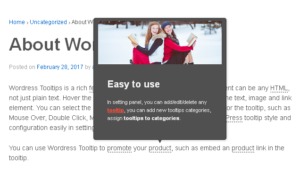
Tooltips are compact popup boxes that provide additional information such as videos, audios, images, Google Maps, QR codes, Wikipedia articles, and text. When users hover over an element on your web pages, such as a word in a post, a search form input box, an image, or a sidebar widget, tooltips seamlessly appear to offer engaging details. The WordPress Tooltip plugin grants the capability to apply tooltip effects to any element within WordPress posts, menus, comments, contact forms, WooCommerce products, bbPress forums, BuddyPress activities, and more. This plugin boasts an array of captivating components and addons, including the delightful Bullets Screen feature. 🙂
Introducing the WordPress Tooltip Plugin
WordPress Tooltip Pro is a plugin specifically designed to enhance your WordPress website with visually appealing and versatile tooltips. It allows you to create captivating tooltip styles that beautifully present content to your users, all while optimizing screen space.
When a user hovers over an item, a vibrant and animated tooltip popup box is displayed. You have the flexibility to incorporate various forms of content including videos, audios, images, and even third-party generated content from plugins like QR codes, Amazon ads, and Google Maps. All of this can be effortlessly added via the standard WordPress editor, making it incredibly user-friendly.
As a novice, learn the process of creating your initial tooltips using the WordPress Tooltips Pro Plugin
- WordPress Tooltip facilitates the effortless creation of tooltips. We will guide you through the process of adding tooltips step by step.
- Log in to your account on the WordPress Tooltip Plugin website.
- If you haven’t installed the WordPress Tooltip Plugin yet, please log in to your account on the WordPress Glossary Tooltip Plugin website. If you have already installed the WordPress Tooltip Plugin, you can directly proceed to step #10.
- Look for the “Download” link on the top menu bar or simply click this link: [link to WordPress Glossary Tooltip Plugin] to download the WordPress Tooltips Pro Plugin.
- Access the admin area of your WordPress site and log in.
- Navigate to the “Plugins” menu item.
- Deactivate the previous version of the tooltips plugin.
- Delete the old WordPress Tooltip Plugin.
- In the “Plugins” menu item, click on “Add New” at the top of the plugins panel.
- Upload the zip file of the tooltips plugin that you downloaded from the WordPress Glossary Plugin website.
- Activate the latest version of the WordPress Tooltip Pro Plugin.
- Navigate to the WordPress admin sidebar. Click on “Tooltips” and then “Add New” to initiate the addition of a new WordPress tooltip.

- Within the WordPress post text editor, you have the freedom to incorporate various HTML elements into the tooltip. These elements may include images, links, and text.

- Congratulations! You have now successfully included a WordPress tooltip. When you hover over the designated keyword, the tooltip will be triggered. Additionally, our WordPress tooltip plugin offers a multitude of customization options to enhance the appearance of your tooltips. These options encompass parameters such as text color, background, font size, width, shadow, opacity, trigger method, and more.
- Video tutorial:
How to link or associate wordpress tooltip to a given element?
1. Please create a new wordpress tooltip term, in wordpress dashboard, you can click on the “Add New” submenu item to open the Tooltips Creator. The interface will resemble the tooltips editor shown below:

tooltips editor
2. In the above diagram, you’ll notice a metabox labeled “Tooltips for Forms.” However, it should actually be titled “Tooltips for Classes.” We made this change because we observed that the most common use cases involved adding tooltips to form elements or fields using CSS classes or IDs. This alteration is intended to help users understand the metabox purpose as tooltips for forms.
3. Simply enter the CSS class or CSS ID in the “Tooltip for Forms” input box where you want to apply the tooltip effect:
For example, tooltips for class:
.input_box_1
or tooltips for ID:
#text_box_2
If you’re unsure how to find the CSS Class or CSS ID for a specific component in WordPress, please refer to the guide titled “How to Find a CSS Class or CSS ID of a Component in WordPress Page?“
4. Make sure you’ve entered the tooltip title and content in the tooltips editor, then click the “Publish” button.
5. On the frontend, when you visit a page that contains the specified CSS class or CSS ID, hovering over the class element will trigger the display of the tooltip content in a tooltip window.
6. Here to check tooltips for class DEMO , you can see a demonstration of wordpress tooltips for classes. In the form, as you hover over each field, a dedicated tooltip window will appear. This way, you can add tooltips for various CSS classes or IDs on the frontend. For instance, you can have tooltips for contact forms, images, videos, buttons, menu items, maps, text, and more.
7. Please note that within the tooltip editor, you can customize unique and visually appealing tooltip styles for each tooltip term. Additionally, you can apply different animations for individual tooltips.
Conclusion:
WordPress tooltips user can add tooltips to specific elements within their WordPress website, such as form fields, form labels, menu items, button, or any other interactive elements. By linking or associating tooltips to these elements, they can provide additional information, instructions, or clarifications to users when interacting with these elements. For example:
- In a form field, a tooltip can provide guidance on the expected format or provide a brief description of the input required.
- In a form label, a tooltip can provide further explanation or examples for the label’s purpose.
- In a menu item, a tooltip can offer a brief description or indicate the functionality of the item when hovered over. The user’s feature request aims to improve the user experience by reducing ambiguity, providing helpful hints, or giving users more information about specific elements. This can lead to better usability and understanding of the website’s features or input requirements.
- …etc
The feature of “Tooltips for anything” — can improve the user experience by reducing ambiguity, providing helpful hints, or giving users more information about specific elements. This can lead to better usability and understanding of the website’s features or input requirements.